Quetta sit-in at Koyla Phatak: A rallying cry for peace and resource sovereignty by Balochistan's Pashtun masses

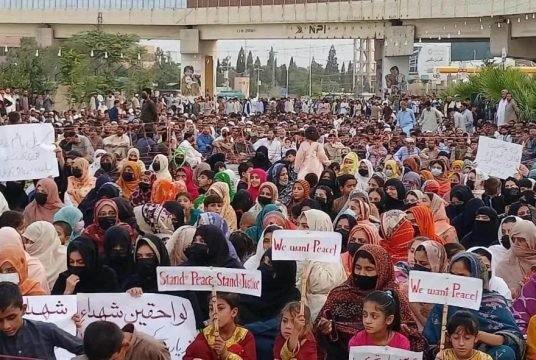
I have come to Quetta from Islamabad for the summer vacations. However, upon arriving in Quetta, I found out that opposite Quetta Cantt on Airport Road, near the BA Mall, a sit-in by the martyrs of Hanna Urak is underway. The next day, I learned that another sit-in has been started at Koyla Phatak against the brutal killing of police personnel in Ziarat. A few days ago, the organizers of the Hanna Urak sit-in announced the end of their protest after negotiations with the Balochistan government, while the sit-in against the martyrdom of police officers in Ziarat has been ongoing for the last eight days. I am continuously participating in this sit-in.
A vast number of people are present at this ongoing sit-in at Koyla Phatak. Young people belonging to the Pashtun, Baloch, and Hazara communities, along with workers of political parties, participate in large numbers on a daily basis. The organizers and participants are running this sit-in on a self-help basis. Various speakers and participants of the sit-in agree that the primary cause of the worst incidents of lawlessness in Balochistan and its Pashtun belt is the colonial policies of the state of Pakistan, due to which the entirety of Balochistan is bathed in blood today. Various workers of nationalist parties participating in the sit-in shared that such a protest sit-in is happening in Quetta’s recent history after a long time, in which workers from all nationalist and religious parties, along with a large number of the public, are participating in a protest and political process. Demonstrations of solidarity with the sit-in have expanded and spread to Pashtun and Baloch districts.
It was a historic protest sit-in in many aspects. A large number of women and children were present at the sit-in. Most importantly, for a whole one day, the stage was entirely managed and run by women. Female students, young girls, and women belonging to various areas of Balochistan’s pashtoon belt addressed the gathering on that day.
In the history of Southern Pashtunkhwa—at least according to my memory—this is the first protest sit-in where women are participating in political activism in such large numbers. For the first time, I got the opportunity to directly listen to a large number of subaltern Pashtun women.
I listened to all the speeches very attentively. There was a deep sense of seriousness in every speech. There was anger regarding the Ziarat martyrs and the overall situation in Pashtunkhwa, but within that anger and mourning, there was also hope and determination. The female speakers maintained a very clear stance, using strong political vocabulary. The Ziarat incident and the Pashtun national question were at the forefront of every speech.
All the speeches by the women were excellent . They spoke with great political clarity on the Pashtun question and urged the parents present at the sit-in to make their children a part of the political process, so that an organized struggle could be fought against these dark forces.
The four fundamental demands of the sit-in:
- A judicial commission should be formed regarding the killings of police in Ziarat.
- The Frontier Constabulary (FC) should be withdrawn from the Pashtun areas of Balochistan.
- The Levies Force should be restored and Levies and police should be equipped with modern weapons and given proper authority.
- All armed groups including TTP should be withdrawn from the pashtun areas of Balochistan.
For some time now, the situation in Balochistan’s Pashtun belt has deteriorated severely. Armed men under the name of Tehreek-e-Taliban have suddenly appeared in Killa Abdullah, Quetta, Zarghoon Ghar Ziarat, Harnai, Sherani, and Zhob. On the other hand, local residents and analysts in Killa Abdullah and Chaman say that state-backed armed commanders linked to the drug and smuggling trade, along with former Afghan Army personnel, are roaming around openly in the form of armed gangs. These armed gangs are involved in various violent incidents. Because of these different armed gangs, neither the highways nor the cities and villages are safe in the Pashtun areas of Balochistan.
A few days ago, at a short distance from Quetta Cantt in Hanna Urak, armed men under the name of the Taliban attacked a village. Four people were killed in this attack, and eleven innocent people were kidnapped and taken away. Similarly, at Mangi Dam in Ziarat, armed men under the name of the Taliban attacked the local police, resulting in the deaths of 30 police personnel. On the other side, the detained leader of the Baloch Yakjehti Committee, Mahrang Baloch, claimed in a statement that former Afghan Army personnel are participating as mercenaries in military operations against the Baloch people in Baloch areas.
Addressing the protest sit-in in Quetta, Member of the National Assembly and Chairman of Pashtunkhwa NAP, Khushal Kakar, said that after passing the Mines and Minerals Bill, the provincial government has allotted hundreds of thousands of acres of historical communal land (*shamilat*) belonging to various tribes in Pashtun areas to different companies and individuals. Violence and unrest in the Pashtun areas of Balochistan are being artificially fueled to seize lands and plunder the mineral resources of the region.
Baloch National Party chief Sardar Akhtar Mengal addressed the sit-in, stating that the state of Pakistan is only interested in Balochistan’s resources and land; they have no interest in the people living in this province. He lamented:
“When the honor and dignity of the Baloch nation were being violated, and when the dupattas were being pulled off the heads of our mothers and sisters, we hoped that some Bacha Khan or Samad Khan would come to support us, but they did not come. However, today, when the Pashtun people of Balochistan are facing similarly terrible conditions, we and the Baloch people stand with you and will stand together until the end.”
National Democratic Movement leader Mohsin Dawar addressed the sit-in, stating that the state of Pakistan has lost its moral, political, and legal justification as a state. This state has now turned into a fiefdom. In this state, a certain group wants to control everything on the basis of sheer force. Regarding nationalities, he said that besides the Baloch and Pashtuns, Kashmir—which you call your jugular vein—has also realized your reality. Similar sentiments exist in Sindh as well; these forces have now concluded that we will protect our resources from your looting through force and political processes. Speaking on terrorism, he said that the armed gangs present under various names in Pashtunkhwa are all state-backed elements, whose purpose is to once again turn this homeland into a battlefield for imperialist wars, and the protocol being received by Pakistani generals all over the world is a series of links in this very chain.
Rafiullah Kakar, an intellectual from Balochistan, wrote in his Facebook post that Balochistan’s Pashtun belt is going through the worst conditions in modern history. As a result of state policies against the backdrop of the Afghan Jihad and the so-called War on Terror, the Pashtun youth organization, Pashtun Tahafuz Movement (PTM), came into existence. Following the rise of the Afghan Taliban to power in Kabul, Balochistan’s Pashtun borderland has been turned into a battlefield for proxy wars. On one hand, armed gangs are roaming around in the name of the Taliban. On the other hand, state-sponsored armed commanders, along with individuals belonging to the former Afghan Army, are freely moving around as armed groups. By closing the Afghan border, the state has put the livelihoods of millions of people at stake. Innocent Afghan refugees settled for three generations have been brutally expelled, but on the other hand, armed men of the former Afghan Army are roaming freely in the Pashtun areas of Balochistan. This state policy resembles the policy implemented in Waziristan. This is the same old policy of “good and bad Taliban” which has now been enforced in the Pashtun areas of Balochistan. The state now wants to use these “good Taliban” against the “bad Taliban” and Baloch separatists.
Professor of Quaid-e-Azam University and central leader of the Awami Workers Party (Marxist), Aasim Sajjad Akhtar, wrote on his Facebook account regarding the recent situation in Balochistan’s Pashtun belt that the state’s old policy of “death squads” in Baloch areas has now spread in a unique manner into the Pashtun areas of Balochistan. According to him, one outcome of this death squad policy in Baloch areas is that the strength and reach of separatists have increased far more than before. Behind this bloody game lie Balochistan’s massive mineral resources, border trade worth trillions, and the economic questions of the coastal belt. The question is: why is what Weber calls the state’s monopoly on violence outsourced, and why are these disastrous policies repeated over and over again?
There is no news about this protest sit-in or the general situation of Balochistan in Pakistan’s mainstream media, and there is a sort of complete blackout. In the mainstream media, only the stance of the military and its backed provincial government is presented regarding the situation in Balochistan. Pakistan’s militarized and Punjabi-majority state views the Balochistan issue mostly as a security and law-and-order problem. They want to solve every political issue in Balochistan with violent force. They make and break governments in Balochistan through extensive political engineering and rigging. Such a puppet political leadership has been imposed on the province, which is accountable to no one but the military, and things have now reached a point where it is commonly said among the vast majority of the province’s population that the writ of the current provincial government is nowhere to be seen outside the Red Zone.
Most leaders of the parliamentary and moderate nationalist political leadership belonging to Balochistan are now saying that the federation created in the remaining Pakistan after the independence of Bengal has completely failed. According to them, to save the situation from further bloodshed, there is a need for a new social contract among the nationalities living in Pakistan to prevent further destruction.
In the dominant discourse of mainstream Pakistan, the Balochistan issue is sometimes framed as a law-and-order issue, sometimes as a problem of backwardness and development, and at other times as a Taliban issue. In this entire discourse, the imperialist and colonial logic of the state of Pakistan is ignored—the very logic due to which the Baloch and Pashtun homelands have been turned into slaughterhouses.
Since the inception of the state of Pakistan, the relationship between Balochistan and Pakistan has stood on colonial foundations. For the past seven decades, Pakistan’s militarized state has been operating in Balochistan under the colonial logic of ‘extractivism, continuously plundering its natural resources and land. To perpetuate this plunder and crush any resistance, the militarized state has imposed a very violent system of governance similar to the one previously enforced in these regions by British colonialism. Today, from Balochistan to Pashtunkhwa, Kashmir, and Gilgit-Baltistan, the national question in Pakistan has taken an explosive form. If the nationalities and other oppressed classes do not organize their struggle against the violent rule of the militarized state through a collective struggle, nothing can save this region and country from civil war and anarchy.